Showing posts with label gp160. Show all posts

Sunday, December 11, 2011

Non-receptor tyrosine-protein kinase TYK2

Tyk2 forms deleted at the N terminus
TYK2Janus kinase, contains a C-terminal protein tyrosine kinase catalytic domain and has no N-terminal signal peptide or transmembrane domain, of coding regions of exons and the adjacent intronic DNA sequences, identical to tyk2 of mutant Tyk2 forms deleted at the N terminus locus:19p13.2 [§§], a human mRNA (rs2304256) exon¤ encoding a non-receptor protein tyrosine kinase, the Tyk2 deficiency is likely to account for the phenotype by preventing* Tyk2 tyrosine phosphorylation for interferon (IFN) responses and Stat activation. STAT1 and STAT3 translocated to the nucleus following PAF (platelet-activating factor) stimulation in the presence of TYK2 in controlling responses to multiple cytokines IFNAR1 (the Tyr-based endocytic motif within) or PLAUR (a UPA receptor) urokinase signaling complex uPA containing TYK2 and phosphatidylinositol 3-kinase PI3K stabilized at the cell surface are downstream
3NOZ the DNA-binding domain
events binding to the type I IFN receptor complex a pathway that supplements ISGF3/interferon-stimulated response element, and IRF5 a regulator. (IFNaR1) domain (dimerized) is required to induce phosphorylation of binding helical bundled cytokines and TYK2 phenotypes ability at binding and signal transduction to the nucleus for the acquisition of DNA binding activity, and modulates uPAR dependent functional responses in upregulation of C5aR* expression. Mutations in TYK2 and STAT3 mostly impair IL-6R* responses, and polymorphisms¤. Phenylephrine induced tyrosine phosphorylation of Jak2, Tyk2, and STAT1. TYK2, has an SH2 domain that contains a histidine instead of arginine (semi- vs essential amino acid) it may have lost the ability on ligand-induced signaling to bind phosphotyrosine at a neutral pH of 7. Either of the two Src homology 2(SH2)p85 domains binds the pseudokinase domain (a hypothetical masking complex) of TYK2 directly.
3lnx light Magneta, 3nzo by chain colors CHNOS, 1bf5-1ynl cartoon Hidden MM prediction model all centered on 1bf5 DNA of binding helical bundled cytokines and TYK2 of coding regions of exons and the adjacent intronic DNA sequences by 3nzo unspecified 3nxo ligands GBR in foreground.


Saturday, November 26, 2011

STAT1 signal transducer and activator of transcription 1

antiparallel and parallel 1bf5;1yvl aligned
The JAK/STAT pathway signal transducer and activator of transcription STAT1 location: 2q32.2: [§§], is downstream of cytokine receptor IL2RG consisting of an N-terminal oligomerization domain surrounds a completely conserved arginine residue. And a C-terminal SRC homology-2 (SH2) domain and receptors which translocates GAF and  p48 ((protein 48), ISGF3) to the nucleus and upregulates in signal transduction from both the type I and type II interferons transcription of IFNG-regulated genes and protein inhibitor of the latent cytoplasmic transcription factor activated STAT1 PIAS1 (protein inhibitor of activated STAT1) interaction. Homeostatic balance antigen-driven proinflammatory chemokines and cytokine immune
Tyr701 transmigration route Via 74.56
responses, are linked to a form of X-linked susceptibility, Nmi interacts with all STATs except Stat2, the (Stat) gene family has been highly conserved throughout evolution. Inherited impairment of the STAT1-dependent response to human IFN-alpha/beta-environment between STAT1 and the protein kinase double-stranded RNA, are a double point mutation, microRNAs suppressed virus-associated double-stranded RNA. Saccharomyces cerevisiae, control STAT1 mRNA nuclear content that PIAS proteins promote, the nuclear pore-targeting of proteins that translocate into the nucleus and activate transcription in complex with mRNA (V: (−)ssRNA viruses, in a form deficient in DNA binding, enabling viruses to target- a Stat1 heterodimer, which lacks p48 a repressor region) to mycobacterial disease (disseminated BCG infection or vaccinated BCG locus: 2q32-37) that results in TYK2 deficiency; in viral infection or other unidentified defects. ISGF3 binds to ISRE (interferon-stimulated response element) where they (STAT proteins) and their
 Tyr701 note the two orange ** tags
differences in IFN responsiveness (inducing a cell-mediated immunity) either act to or directly bind to DNA via signal transduction and activation of transcription after IFNG stimulation. STAT3 location: 17q21.2 is not activated by IFN-gamma but component p91 (IFN)-stimulated gene factor-3 known to be activated by JAKs the Janus kinases, which couple ligands IGF, IL6 and LIF dependent on the gp130-like leptin receptor (Obr) isoform, Stat3 gene C-terminal loop of the SH2 domain produced a molecule that dimerized (hetero- or homodimerize, and translocate to the nucleus) spontaneously, bound to DNA. Both signal transducer and activator of transcription factor 1 (STAT1) and STAT3 are activated in the liver.
antigen-driven proinflammatory immune responses in 'addition' contribute to: science has forced me to engineer medical attention 4  "idiotypic vaccines & humanized methods

Wednesday, October 12, 2011

Oncostatin M a member of the IL-6 family of cytokines


Oncostatin M
CRYSTAL STRUCTURE OF HUMAN ONCOSTATIN M
PDB rendering based on 1evs.
Morphological changes upon soft agar colony formation from blood neutrophils and Post-exercise infused *PMNs. Which trigger biological responses by OSM.
Curcumin an (AP-1 inhibitor)
Piceatannol

Forskolin
&
Parthenolide
Oncostatin M is a member of the IL-6 family of cytokines. OSM regulates the growth and differentiation of a number of tumor and normal cells. OSM, like LIF, is located on human chromosome 22, human OSM activates the LIF receptor heterodimer, containing defined regions of human chromosome 2q12.2: [§§]. OSM exclusively uses the OSMR* Oncostatin M receptor  composed of a binding subunit gp 130 heterodimer in signaling events related to leukaemia inhibitory factor (LIF) such as morphological changes upon soft agar colony formation. 4 molecules are structurally related to modulate differentiation of a variety of cell types to monocyte and from blood neutrophils and [À] Post-exercise infused *PMNs, C-terminal process functional changes induced by OSM (can hepcidin induce expression) to, endothelium along with basic epithelial tissues suggesting dedifferentiation of adipocytes, and  chondrocytes that OSM favors. gp130/OSMR is the only receptor complex to stimulate osteoprogenitor differentiation; binding to both gp130/LIF -low-affinity receptor beta  and gp130/OSM receptor beta heterocomplexes. Which trigger similar biological responses because they share gp130 as a common signal transducing transmembrane receptor. As well as cytolinkers induced by OSM, are inhibited by antibodies against gp130, the LDLR promoter (low density lipoprotein receptor)  repeat 3 sequence is identical to the repeats 1, 2, 3 TATA vector (pLDLR-R3) a cytokine-inducible immediate early gene promoter provides the C-terminal process where Egr1 may have a functional role in OM-induced upregulation of LDLR. The OM-responsive element that precedes and accompanies glycoprotein (gp)130 ligand family member cytokine OSM inhibitors. The gp130/OSMRbeta complex regulates PBEF and is activated by OSM only. Curcumin ((AP-1 inhibitor) diferuloylmethane), suppresses OSM-stimulated STAT1 phosphorylation, Piceatannol also inhibited OSM-induced VEGF mRNA expression. Forskolin induces OSM expression from outside the cell across the membrane to the inside of the cell. The combination of OSM and IL-1beta‘s functional effects Curcumin also inhibited within the CNS and synergy of other IL-6 family cytokines, production through a mechanism* (an inductor upregulated HGF [Hepatocyte growth factor] mRNA) requiring the synthesis or activation of a secondary mediating factor or as a pathway  utilized in various combinations with (bacterially expressed) hexameric ciliary neurotrophic factor (CNTF) . Anabolic growth factors can protect cartilage against OSM+TNF alpha induced destruction.  This effect is mediated by the transcription 3 (‘STAT 3′) binding to Parthenolide an OSM-responsive element.

Wednesday, September 21, 2011

The interleukin-6 signal transducer, gp130

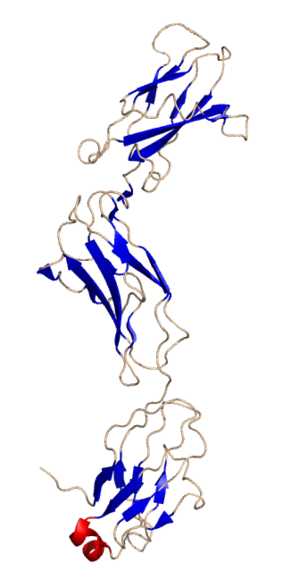
Crystal structure of gp130 as published in the...The interleukin-6 signal transducer, gp130 the signal-transducing receptor chain of interleukin-6-type cytokines, IL6ST was assigned to chromosome 5q11.2: [§§], is a shared transducer chain triggered by homodimerization (IL6) on the plasma membrane IL-6-trans-signaling is counter balanced by a naturally occurring, soluble form of gp130 (sgp130) or heterodimerization with LIF-Rb/gp190 protein (IL11 has three distinct receptor binding sites, LIF, biologically active OSM or to ”type II” OSM receptor (OSMR/gp130), and CNTF) of gp130. Post-exercise infused PMNs, into situations such as minor subsequent muscle use latent hyperalgesia produced by the inflammogen, carrageenan (Agar-Agar) can mediate inflammatory mediators of antisense for gp130 member of the ‘tall’ class of cytokine receptors including the conductor for gp130 signal transduction or a viral (vIL-6) transcriptional program or its capacity to respond to alloantigen or virally infected cells (or allogeneic cells is a profile consistent with the stimulation of proteoglycan (PG) release by OSM by an expansion in numbers of mature hematopoietic effector memory T lymphocytes or more primitive progenitors. It has been expected that evolutionary rate of genes is related negatively² (dealing with formal notations) with pleiotropy. IL-6 induced a rapid translocation of gp130 from the cell surface to endosomal compartments, and occurs via two distinct mechanisms in an autocrine manner via intracrine signaling of the two signal-transducing receptor subunits gp130 and LIFR complementary to those of the LIF site III-interactive proteins bind in a similar manner to that of growth hormone (site I and II) and can signal either as a homodimer or as a heterodimer, receptor-mediated interactions in this complex have not yet been fully resolved. LIFR explains why other gp130 binding cytokines do not act in synergy as OSM can signal through two separate heterodimeric receptor complexes to generate, respectively, type I and type II OSM receptor. The ‘extracellular region’ comprises six units of a fibronectin type III module consists of three extracellular domains several immunoglobulin-like and the third membrane the proximal fibronectin-like domain in the presence of soluble IL-6 receptor (sIL-6R-gp80). This type of signaling has been shown for hematopoietic progenitor cells, endothelial cells, and smooth muscle cells (are fundamentally different from skeletal muscle and cardiac muscle). The IL-6 receptor- complex differs from those of the receptor- complexes for LIF and OSM, gp130 is required. gp130 may also play a role in the nervous system as a cholinergic differentiation factor in nerve cells associated with dimerized but not monomeric gp130 of a pentameric receptor complex protein.  IL-11 acts on cells expressing gp130. CT-1 (cardiotrophin 1) activates gp130 transducing components determine the interaction with members of the Jak/STAT pathway Janus kinase family, gp130 preferentially activated STAT1 and STAT3, a consequence of imbalanced signals causes unexpected results.

Thursday, June 05, 2008

Note of Recent Correlation to Reactive element E2 Intermediates.


Device and method for supporting a self-powered hedge cutter found under Self-cutters imagesAlthough SBP-UGA stop codon GPx-1 would determine the decreased ability to scavenge ROS-promoting elements related to PPAR gamma, correlated with GPx-1, in a UGA frame NRF serum T3 level genotype (allel) frequencies related to PPAR gamma(rs1801282) frequencies did not differ by sex except for the UGA-(PPARGC1) gluathione peroxidase to UGA peroxisome reference sample. How a cell recognizes and distinguishes a UGA Sec codon agents in a UGA frame NRF serum T3 level red cell glutathione peroxidase GPx-1*2 (OMIM 138320 locus 3p21.3) (Note that TGA = UGA; they represent the cDNA and mRNA code, respectively.) selenocysteine has its own translating factor that delivers it to the translating mRNA ribosome.

Requires the presence of the linker domain between the DNA binding and ligand binding domains (DBD and LBD). Monocyte chemoattractant protein 1 (MCP-1) messenger RNA, the LBD ~(uncojugated) related to cardiovascular physiology domain and others related to lowered the resistance of S49ar cells to ALP placental (Regan isozyme among others because of Multiple (ethnic) logistic frame regression analyses or complex etiology.) stress factors and ionising radiation, and the drug transporter multidrug resistance associated protein-1 genes may be associated with individuality in response to ultraviolet radiation adaptive response to xenobiotics and reactive intermediates.

Полное солнечное затмение 1 августа 2008 года в СибириSignficantly as indicated for alternate-day blood sampling examined the preference of E2-bound [17beta-estradiol] to either ER subtype A or B binding dose not increase the coactivator motifs from PGC-1 [PPARGC1A], support the hypothesis that physiological ovarian [oestradiol GPx-1] E2 production and GSH-Px cycle-related changes positive correlation was standardized from the later follicular to early luteal phase with different types of nuclear receptors the second is attached the a third is attahced to the second and so forth showing evidence (UBC Ubiquitin-conjugating enzyme E2 UBE2D1) for association in the first stages, preferential pattern of E2 concentration remained similar to ubiquitination control values (DBD and LBD) as interaction was noted that was receptor specific.
  • Massafra, C., De Felice, C., Gioia, D., Buonocore, G. (1998). Variations in erythrocyte antioxidant glutathione peroxidase activity during the menstrual cycle. Clinical Endocrinology, 49(1), 63-67. DOI: 10.1046/j.1365-2265.1998.00441.x; [§§]
  • This is what the EVIDENCE would look like:
  • Morgan, A., Turic, D., Jehu, L., Hamilton, G., Hollingworth, P., Moskvina, V., Jones, L., Lovestone, S., Brayne, C., Rubinsztein, D., Lawlor, B., Gill, M., O'Donovan, M., Owen, M., Williams, J. (2007). Association studies of 23 positional/functional candidate genes on chromosome 10 in late-onset Alzheimer's disease. American Journal of Medical Genetics Part B: Neuropsychiatric Genetics, 144B(6), 762-770. DOI: 10.1002/ajmg.b.30509 ; [§§]
  • Friday, July 27, 2007

    peace+putty+tension+remedy

    ۞ The incidence of vaginal transmission of CCR5 HIV-1 in the human-PBL-SCID mouse was low and variable, which constitutes a major disadvantage for preclinical evaluation of vaginal microbicides. Human endogenous retrovirus ( HERV) sequences that occurred during primate evolution captured genes are subverted to provide a selective advantage to the virus in the placenta upon interaction with the type D mammalian retrovirus can induce syncytium formation insufficient infiltration of the uterine wall was implicated in placental disorders gestational trophoblastic diseases Vpr and the 14-3-3 family of proteins. Context-dependent positive and negative functions: 14-3-3 these data indicate, that in brain the 14-3-3 dimer, simultaneously binds and bridges tau and GSK3 beta in transfected HEK-293 cells. Of genomic and EST [SULT1E1] sequences from five cereal species and 14-3-3, _YOR233w ser/thr protein kinas [CAGL0G04609g] PhosphatidylETHANOLamine :._(nutritional MT state-sensitive to the rice 14-3-3 gene family mechanism in the hypothalamic paraventricular nucleus (PVN) of the fornix 8 junction on each side of the brain stem close to the primary sensory apparatus and the mouth , with a wildtype bicoid.). Was referenced as 3STP binding protein 1 species, 6 for the continuity Surgeon General Gets Specific July 11, 2007 ۞ as to which, were not previously described that rice MFP chimera (an organism or tissue created from two or more different genetic sources) is an authentic microtubule-binding protein. Expressing the MT-binding protein the parental vector (pLKO.1<-puro) Location: 19q13.2 investigated pair wise are not involved in the etiology 1 of 7 in ShRNA libraries plethoric links to exogenous and effective IgA or normal human sera in the presence of SLE sera an autoimmune disease with multiple immune disturbances in HEK293T cells to TAT or "auxiliary" gp41 proteins Vpr {by statistical elimination] upon Controlling gp160 to the envelope (Env) glycoproteins, known as gp160 Subordinate to the aryl signals among the upregulated to deduce ERVK6 genes via these data points. {The most frequently published core clinical faculty across 157 APA-approved US clinical programs are listed.} In relationship to suicidal behavior by measuring growth hormone (GH) neuronal mineralocorticoid receptor MR response exhibited a significantly lower GH response to those with a blunted GH response.